The Missing Path in Stepwise
· Projects
A few days ago I wrote about Stepwise, my small Duolingo-style learning app. It had four paths.
It has eight now. Flight & Drones goes from the physics of lift to how a flight controller keeps a drone level. Networking & Security starts with cables and IP addresses and goes all the way to ethical hacking. Quantum Computing starts with complex numbers and goes as far as Grover's search and Shor's algorithm.
Then I asked myself a simple question. Imagine you are a kid. Where do you start, and how far can you get?
The wall
You start with Computers & AI for Kids. About two hours of tiny lessons. Then Python Basics. A big jump, but doable at ten with a grown-up nearby. Networking works at twelve.
Then you hit a wall.
The AI path needs algebra. Quantum needs trigonometry. Flight needs calculus. The kids path stops at adding and doubling. Nothing in Stepwise connected the two.
Every advanced path quietly assumed school maths. A grown-up has it, or at least nodded along to it once. A kid doesn't have it yet. So the paths looked like a ladder, but the middle rungs were missing.
Maths Quest
So the new path is Maths Quest. Seventeen units in three tiers:
- Explorer (about 8–11): place value, times tables, fractions, decimals and percentages, negative numbers, shapes.
- Builder (about 11–14): powers and roots, ratio, algebra, equations, graphs, data and chance.
- Master (about 14+): quadratics, trigonometry, functions and logarithms, sequences and vectors, and a first taste of calculus.
The voice grows up with the learner. The first units have short sentences, emojis and cupcakes. The last ones use proper notation.
A few decisions, and why:
No calculator in the early tiers. In most of Stepwise a calculator pops up for number questions. Here it stays hidden. When you are learning 7 × 8, the arithmetic is the whole point.
More practice, less reading. Maths is learned by doing. Each idea gets at least two or three questions with different numbers, not one.
Spot Bolt's mistake. Bolt the robot is back, and he makes the classic mistakes. He adds fractions by adding the tops and the bottoms. He thinks 0.25 is bigger than 0.5 because 25 is bigger than 5. He thinks (a + b)² is a² + b². Finding someone else's mistake teaches more than being told the rule.
Fractions in their simplest form. If the answer is 3/4, then 6/8 doesn't count. Equal is not the same as finished.
It ends by pointing forward. The last lesson is the first taste of calculus. Then it shows which skill opens which path: derivatives for AI, the unit circle for quantum, trigonometry for drones, powers of two for networking.
A map instead of a list
The second problem was the home screen. It was a list of eight cards. Quantum Computing sat right next to the kids path. Nothing told you where to begin.
I wanted something like the graph view in Obsidian, where you can see how everything connects. A free-floating graph is fun on a laptop and fiddly on a phone, though. So it became a skill tree.
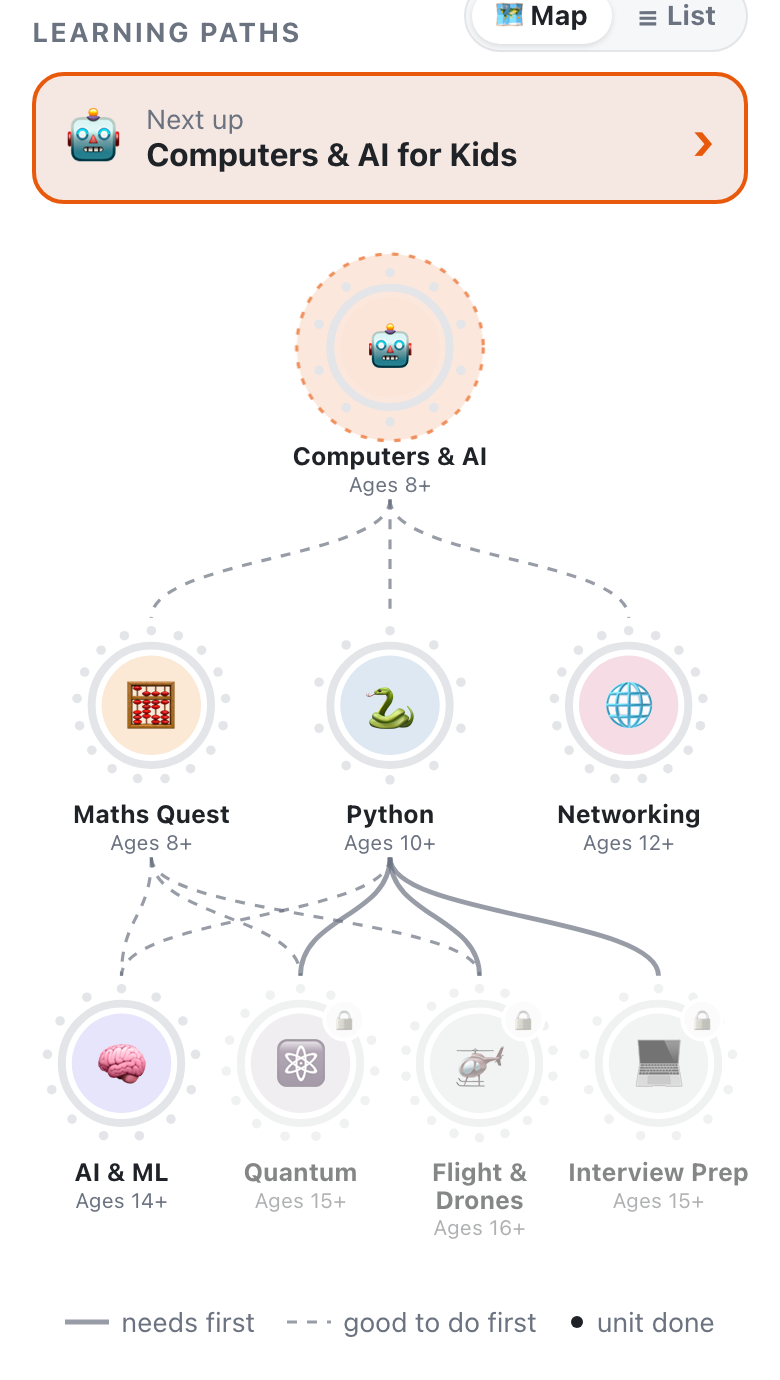
- A solid line means "you need this first". Quantum needs Python.
- A dashed line means "good to do first". Maths before AI.
- The ring around each path fills as you finish lessons. Each small dot is one unit.
- The path you should do next glows, and a card at the top takes you straight there.
- Every path shows an age, so a kid can see what is meant for them.
The old list is still one tap away.
The ladder now
Computers & AI for Kids, then Maths Quest and Python side by side, then Networking, AI, Quantum and Flight when you are ready. It is still a long climb. But there are no missing rungs.
It won't replace a maths teacher. But maybe one day "the derivative is just the slope" will feel obvious, because it started with counting cupcakes.