I Merged Atomic Habits Into My Bullet Journal
· Experience
I listened to Atomic Habits at the gym. I understood it. I implemented none of it.
For a long time I blamed the book. It wasn't the book. I understood every idea in it and still changed nothing, because understanding a system and having somewhere to put it are different problems. I already carried a bullet journal everywhere. The habits had a home the whole time — I just never moved them in.
This is what the merge looks like, in diagrams. If I can't draw something, I don't know it.
First, what the book actually claims
Three ideas do all the work.
Start from identity, not outcomes. Goals end; identity doesn't.
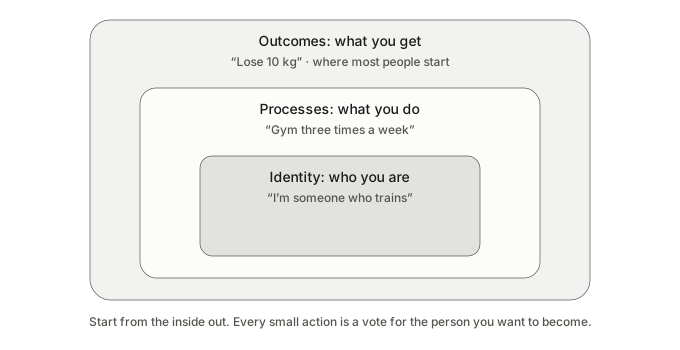
Every action is a vote for a type of person. You don't need every vote — you need a majority.
Every habit is a loop.
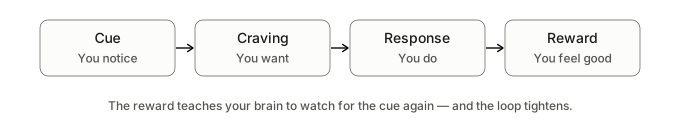
The cue is an interrupt. The craving is the pending flag. The response is the handler. The reward is why the handler stays registered.
Four laws, one per stage of the loop.
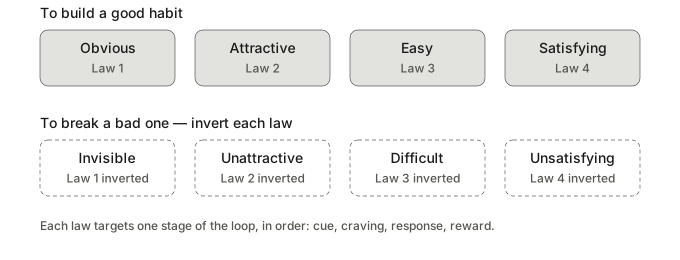
Make it obvious, attractive, easy, satisfying. Invert each to break a habit instead. The best line in the book: you don't rise to the level of your goals, you fall to the level of your systems.
That's the whole book. The rest is examples.
The technique I kept: stacking onto meals
I have more hobbies than evenings and none of them had a slot. Stacking skips the clock — you bind a new habit to one you already do.
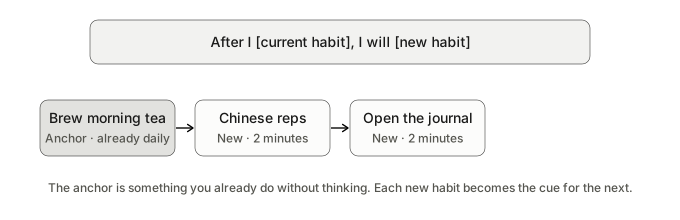
After I [current habit], I will [new habit].
You're not creating a new event source. You're registering another callback on an interrupt that already fires.
The best anchors turned out to be meals. Three of them happen every day no matter how badly the day goes, so I run three short stacks instead of one long one: after tea, after lunch, after dinner.
The merge: every stack ends in the notebook
Here's what the book doesn't give you. Stacking tells you what to do. Nothing tells you whether you did it — and "make it satisfying" is the law that collapses in practice, because the real payoff is months out.
The notebook solves it, and I didn't have to build anything. Logging became the last link of every stack.
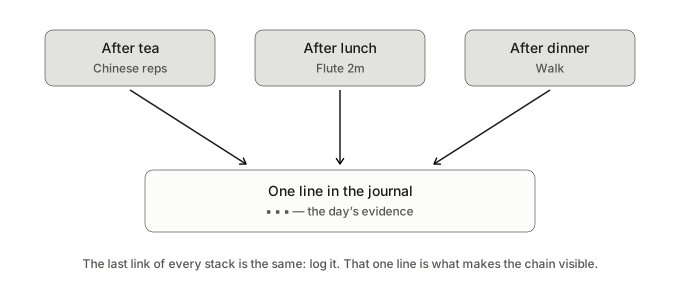
That convergence is what turned a plan into a system. The notebook is already in my pocket, so the cue is permanently present — law one, solved for free and forever.
On the page, habits become a fourth bullet type, alongside task, event and note.
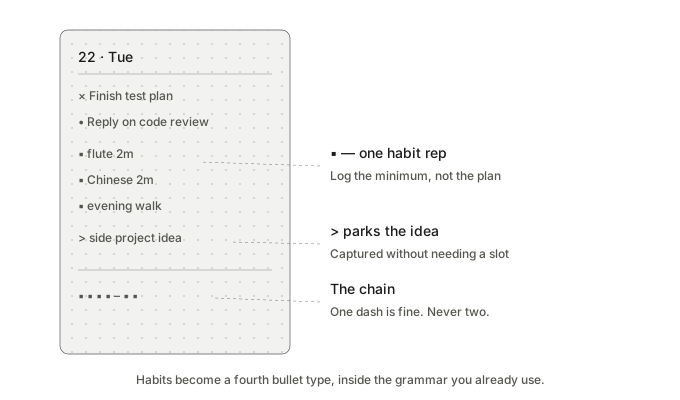
Four rules make it hold:
- Log the minimum. "Flute 2m." Play thirty minutes and it still reads as done. Write down your ambition instead and you'll log failures on days you succeeded.
- One dash is fine, never two. Two misses in a row means the habit is too big. Halve it.
- Migration prunes. Anything under half the days at month end gets smaller or gets dropped. The book says make it easy but never says when to check. The monthly migration is the when — and that ritual already existed.
- Park what has no slot. Ideas go into a collection, not onto a calendar.
An identity page at the front, never migrated: three lines about who all of this is for. The ribbon stays on today's page, so the notebook opens to the cue.
One warning, mostly to myself. If you enjoy building systems, bullet journalling will happily become the hobby. Keep the tracker to one line a day. The moment it becomes a spread with a colour key, the tracking has replaced the doing.
Why the notebook is the whole point
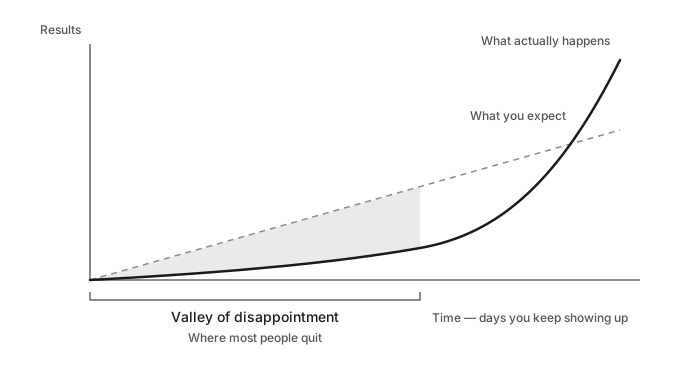
Clear calls the flat part the plateau of latent potential. Ice does nothing visible between -10°C and -1°C either, and then it changes state.
Through that flat stretch there are no results to look at. The chain of ticks is the only evidence the system is running. That's the job the notebook does, and it's why this stuck when six previous attempts didn't.
On the book itself
The identity reframe beats goal-setting, and the four laws are a genuine checklist for debugging a habit that won't stick. It's also repetitive — the ideas are all in the first third — and the "1% better compounds to 37×" arithmetic is a metaphor, not a model. Treat it as a framework, not a finding.
Worth reading, with one caveat: reading it changes nothing. I'm the proof. It's a spec document, and a spec does nothing until something implements it. Mine happened to be a notebook I'd been carrying for years.
Three stacks, three meals, one notebook. I'll report back in ninety days.